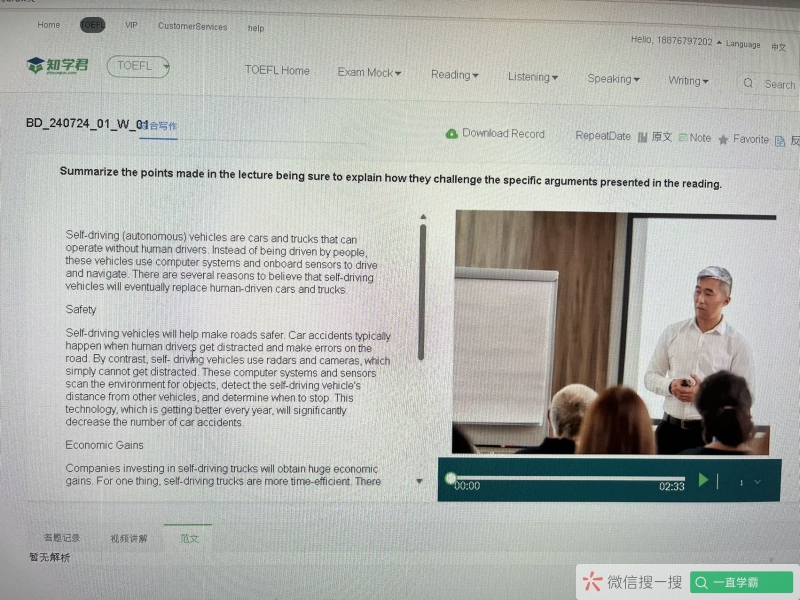
Both the reading and the listening passage delve into whether vehicles using computer systems will replace human-driven cars and trucks. Significantly, the listening content contradicts the reading by presenting three counterarguments.
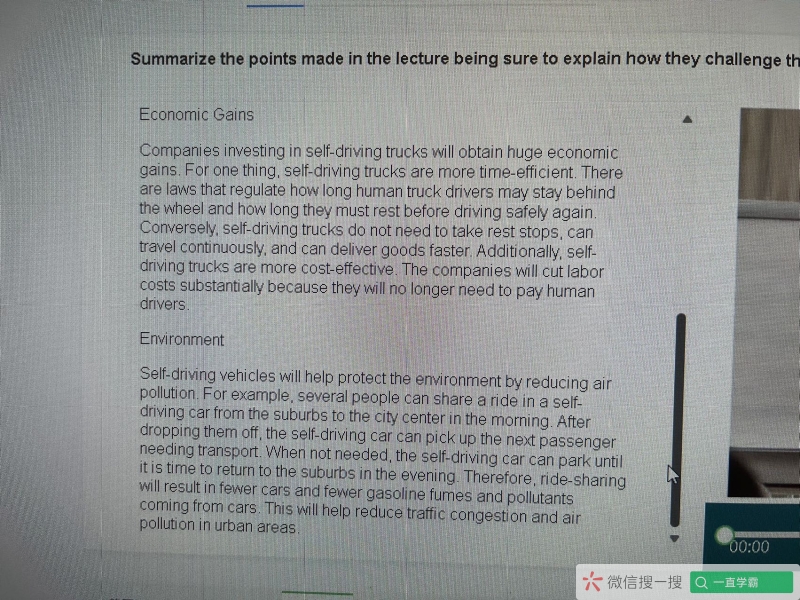
First, the reading material emphasizes the importance of safety since cars are equipped with radars and cameras. By scanning the environment, vehicles determine when to stop, decreasing the possibility of car accidents, which occur when drivers get distractions. However, the listening challenges this statement, highlighting that human-drivers are still safer. Specifically, local animals emerge accidentally and this situation manifests the advantages of human drive. Experiences have shown that Australian kangaroos move at a high speed, which is unpredictable. People are more familiar with them compared to robots. Also, it is obvious that systems are confused by this animal.
Moreover, according to the reading, computer-driven cars are time-saving because robots don’t rest as human drivers and can move faster. Additionally, labors are cut down, leading to the overall cost-saving. The listening refutes this assertion, arguing that computer system cars drive in narrow roads, meeting different cars. Thus, with this perplexing condition, two drivers are needed to cover the workload in order to get to the final destination. Consequently, costs are still high, which is not as ideal as people imagine.
Finally, environmental benefits are to be expected. Given fewer cars running on the streets, air pollution as well as congestions are mitigated. This is because the proper stops depend on passengers. From the perspective of listening, this is not reasonable. Cars park in the center of the cities are expensive. Lower speed driving not only increases the congestion but also elevates the energy use. For this reason, under no circumstances can people eliminate the pollution. 時間有限,學生只能夠寫200字,範文請給200字以內才有參考性 謝謝




评论 0