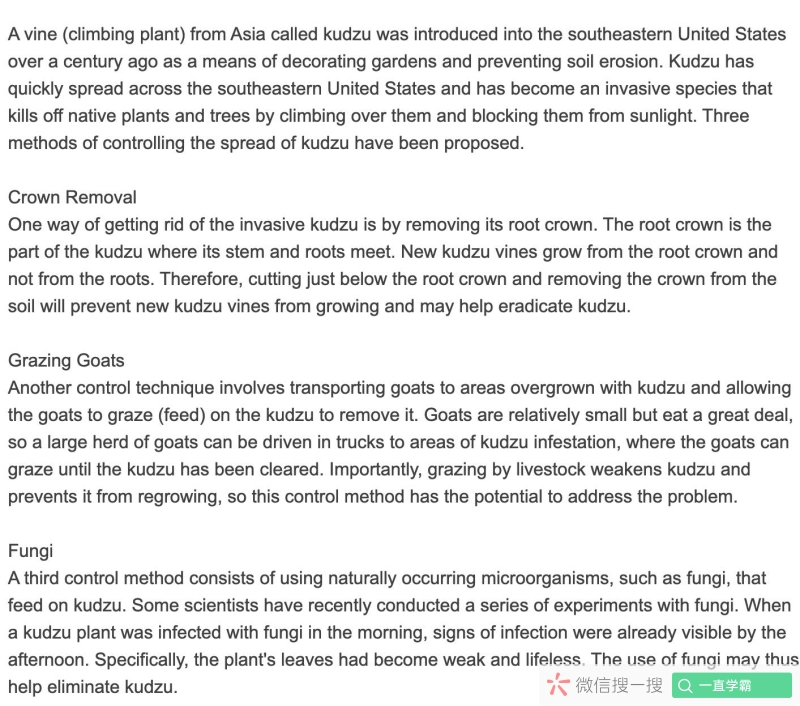
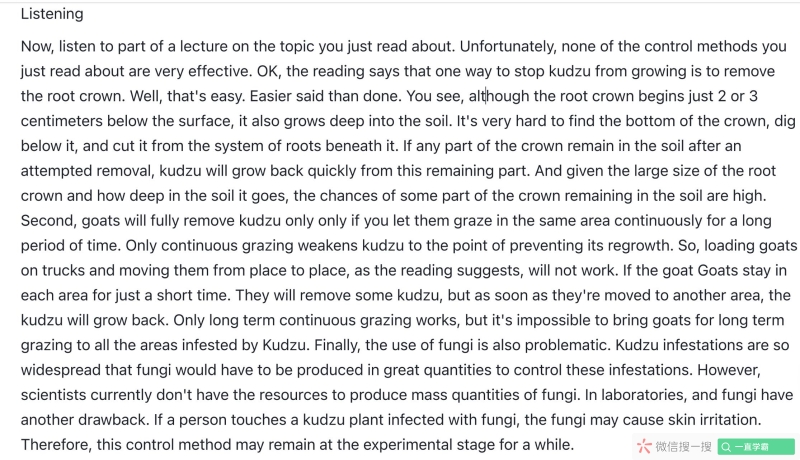
Both the reading and the listening passage delve into the eradication of kudzu. Specifically, the listening material contradicts the reading by presenting three counterarguments. First, the reading asserts a possible measure to eliminate kudzu is to remove its root crown, where the new kudzu grow its new root. By implementing this way, the plants will be significantly removed. However, the listening challenges this statements, highlighting that the roots grow in the deep soil around two to three centermeters. Thus, hardly could people find them and eradicate them. Additionally, they grow at a high speed, making them hard to control effectively. Moreover, the reading content suggests that grazing goats feed on kudzu, and herds of goats play a workable role in eating all of kudzu. Besides, animals clear the roots of the plants, making them hard to grow back. Nevertheless, from the perspective of the listening, under no circumstances could kudzu be fully removed without consecutive and long-time grazing. Practically speaking, grazing in all places are no different from a dream, which means regrowth of the plants are inevitable. Finally, microorganisms are to be expected. Fungi feed on kudze, Experiences from the lab demonstrate the leaves of the plants drastically become less energetic after infection , making the whole kudzu to be faint. The listening refutes this, explaining that there should be a huge amount of fungi that provide a chance of killing all of them. But, scientists lack enough resources to develop that huge quantity of fungi. Consequently, this way is not worth efforts. Furthermore, flaws are to be found that humans' skin are contagious to these fungi, and this is why this control method stop at the experimental stage.





评论 0