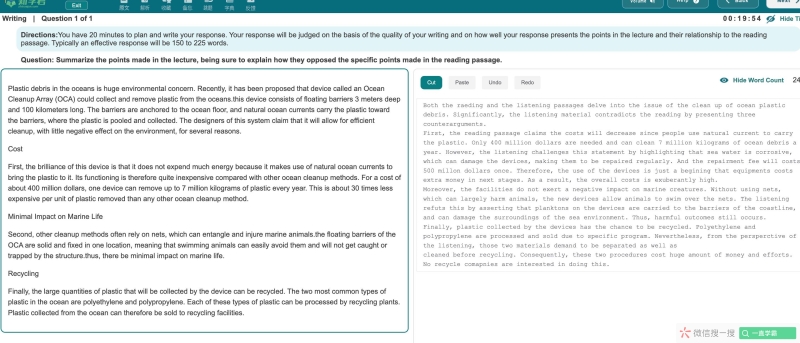
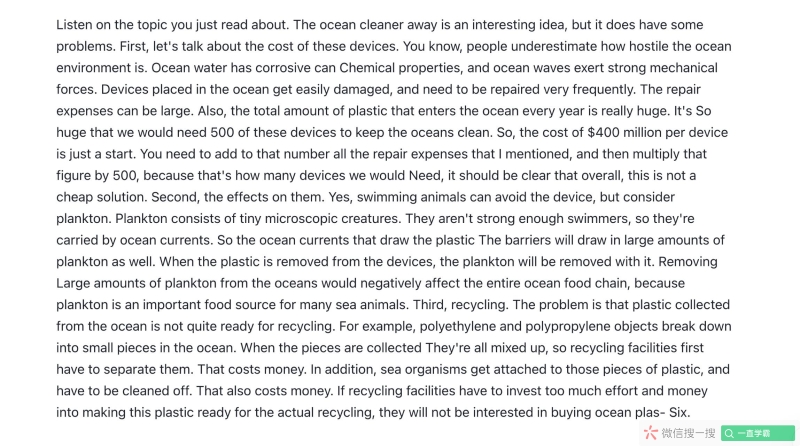
Both the reading and the listening passages delve into the issue of the clean up of ocean plastic debris. Significantly, the listening material contradicts the reading by presenting three counterarguments.
First, the reading passage claims the costs will decrease since people use natural currents to carry the plastic. Only 400 million dollars are needed, and it can clean 7 million kilograms of ocean debris a year. However, the listening challenges this statement by highlighting that sea water is corrosive, which can damage the devices, making them repaired regularly. And the expenses are really high. Furthermore, the garbage amount is high too, so the total number of devices goes to 500. Therefore, the overall costs are exuberantly high. Moreover, the facilities do not exert a negative impact on marine creatures. Without using nets, which can largely harm animals, the new devices allow animals to survive. The listening refutes this by asserting that planktons on the devices are carried to the barriers of the coastlines, and this can damage the food-chains of the sea environment because plankton is the food source of many sea animals. Thus, harmful outcomes still occur. Finally, plastic collected by the devices has the chance to be recycled. Polyethylene and polypropylene are processed and sold due to specific programs. Nevertheless, from the perspective of the listening, these two materials, which were broke down into pieces by the ocean, need to be separated as well as cleaned before recycling. Consequently, the procedures cost a huge amount of money and effort. No recycling companies are interested in doing this.




官方助手
2025-07-11
已批改,2篇