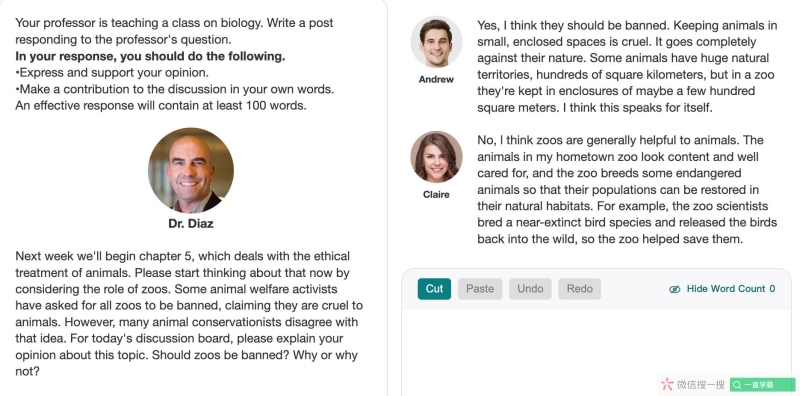
The issue whether people should ban zoos has triggered a lively discussion. Given that zoos provide people with not only learning materials, but they also serve as a place to conduct scientific researches, it is advisable to keep zoos for the overall goods.
On one hand, zoos protect and demonstrate endangered animals as Claire claims, resulting in the abundant learning resources. Imagine adults take children to a zoo, trying hard to teach them about species in the world. This significantly expands the boundaries of students' cognition, paving the way for their exploring of the intrinsic interests. Moreover, zoos are recreational places for parents who want to find somewhere to go to at weekends. It is widely admitted that a trip to zoos is more meaningful and educational than bringing children to shopping malls because its interacting teaching style in zoo parks.
On the other hand, the data collected in zoos allows scientists to better understand species, from their living habits to breeding frequencies. With the information, researchers are equipped with in-depth knowledge to help endangered ones to thrive. For instance, pandas are animals that are hard to breed on their own, with the supervision of specialists, they develop healthier reproductive systems. More panda babies are thus expected in the future.
Although I partially agree with Andrew's assertion that zoos oppose the nature of animals, he overlooks the fact that it is the way that people demonstrate animals in zoos helps raise the awareness of animal protection topics. Without zoo spaces, children lack the concrete examples to contemplate such agendas.




官方助手
2025-07-19
已批改